
Finding Haverford Township Residents
A useful Haverford Township residents directory search does not treat one database as a complete answer. Delaware County keeps property data by address and parcel, while the Recorder keeps parties to recorded land documents. The Historical Society and Library preserve a much older, narrower directory trail. A voter status inquiry, court docket, or vital-record request follows still different rules. The best route depends on whether the starting point is a current address, a full name, a past household, or a document reference.
Use each result for what it can prove. A parcel card may identify a current owner, but not every person connected with the location. A deed follows a transfer, not a household list. An old directory can place a person or business in a locality, but it is not a continuous annual census. Matching a name to an address, time period, and second official source is safer than relying on a single search result.
- For an address, search the Delaware County property system and record its Parcel ID, site address, and map cue.
- Use the Parcel ID or deed reference in the Recorder's public-access tools to follow the recorded-land trail.
- For a named person, compare the evidence with the limited state voter-status route or a public court docket where appropriate.
- For an earlier household, ask the Library or Historical Society for the relevant local directory issue and check historic place names.
- When a needed Township or County record is not online, send a focused request to the custodian instead of guessing what an index omission means.
Note: Keep the date obtained with every result, because current portals and public lists can change after a search.
Haverford Township Records Offices
Haverford Township is a Delaware County municipality, so the key records desks are split between Havertown, Media, Lima, and statewide services. The Township Building is the right starting point for local permits and municipal requests. County offices in Media keep deeds, assessments, marriage and probate material, and court files. The County Archives in Lima handles many older administrative series but does not hold Recorder deeds. This division of custody matters more than a broad name search.
For a street-by-street trail, the property system and Recorder are the first pair to inspect. The more detailed address workflow is on the Haverford Township by-street page. The cards below identify the three starting points most often used to orient a Haverford Township residents directory search.
Delaware County Recorder of Deeds
Government Center, Room 108
201 W. Front St., Media, PA 19063
610-891-4152
Delaware County Board of Assessment
Ground floor, Government Center
201 W. Front St., Media, PA 19063
610-891-4273
Delaware County Voter Registration
Government Center Building
201 W. Front St., Media, PA 19063
610-891-4659
Haverford Township Parcel ID Bridge
The County Real Estate/Tax System is the practical address-first key for Haverford Township. Its address form accepts optional Number and Street boxes, and the instruction says to enter the street name without its suffix. A street-only search can return matching occurrences; a number narrows the result. The property card exposes the Parcel ID, TaxMap ID, site location, legal description, municipality, owner and mailing fields, assessment fields, sales information, and map tab. The site address and an owner's mailing address can be different, so record both as labels rather than treating either one as a statement of occupancy.
The Parcel ID is the bridge to recorded documents. It can be used as a search term in the Recorder's Cloud Search and helps separate similarly named properties. Parcel-ID mode in the tax system accepts an 11-digit identifier without hyphens and permits a wildcard. The County property site no longer offers a name search, which is a deliberate privacy boundary. Use the address route, then preserve the identifier with the search date.
| Tax-system field | How it helps a Haverford search |
|---|---|
| Number and Street | Starts an address query; omit the street suffix and use a number to narrow results. |
| Parcel ID | Connects the property card to map context and the Recorder's recorded-land search. |
| Site and mailing fields | Distinguishes the location of the parcel from correspondence information. |
| Map and legal description | Helps test that the deed and the intended parcel refer to the same land. |
Haverford Township Voter Record Boundaries
Pennsylvania's online voter-status service is a personal registration-status route, not a tool for browsing an entire Haverford Township street. The Commonwealth also directs people to the county office or 1-877-VOTESPA for status help. A match should be treated as regulated civic information, not proof that every adult connected to an address is registered or currently present there.
For a properly authorized civic use, the state voter-list form provides a separate Street List arrangement. Its listed fields are name, residential address, mailing address, party, and active or inactive status. State law requires identification and a written statement about the permitted purpose before voter information is inspected or acquired. It also bars electronic signatures and SURE registration numbers from public information lists. The current-status tool and a street list are different access channels with different limits.
Pennsylvania's voter-status page is the state route for an individual inquiry.
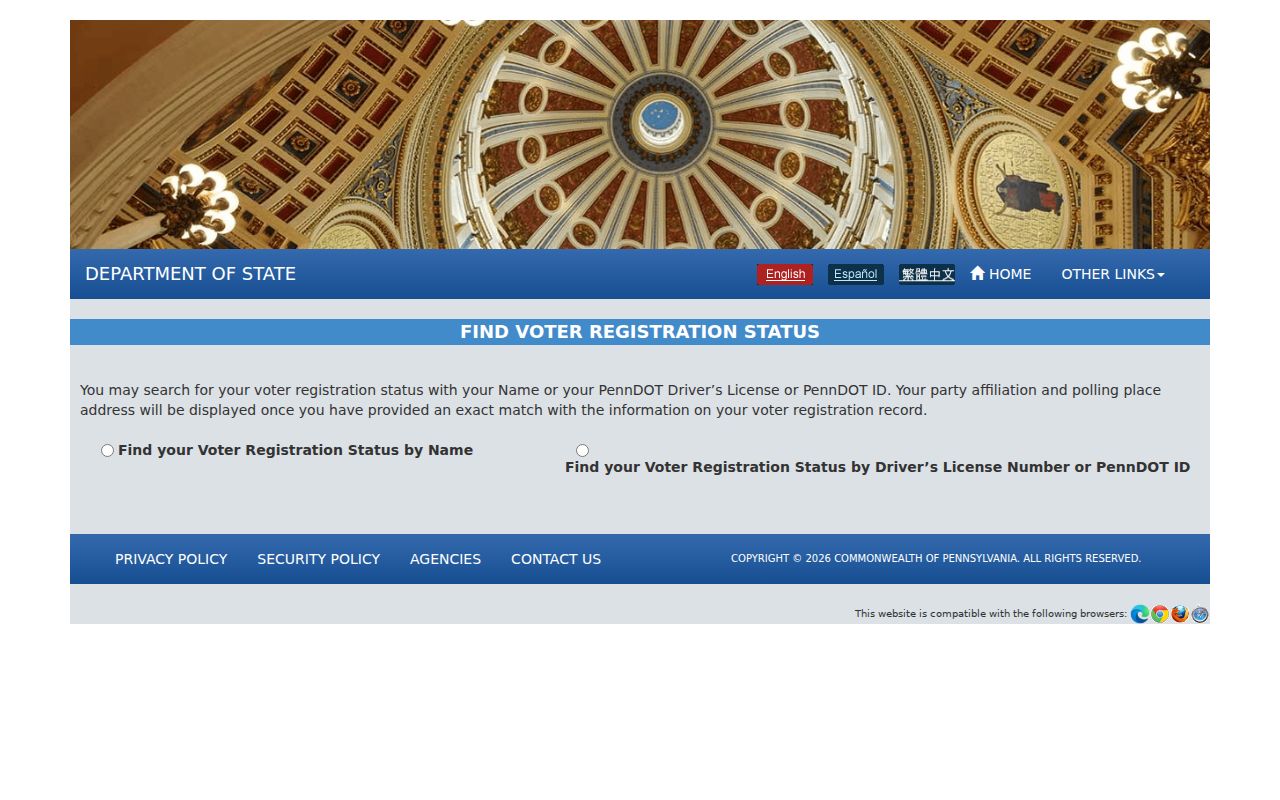
The state screen is designed for status confirmation, while broader voter-list access follows a separate regulated process.
Haverford Township Recorder Search
Recorded land documents supply a durable Haverford Township ownership trail. The Recorder says its real-property records reach back to 1789, while the County describes online copies as available from 1799 forward. Cloud Search and the older CountyFusion route are both official access paths. A deed records transfer parties and the land reference. It does not identify everyone associated with a location.
Cloud Search accepts a broad search term for grantor, grantee, subdivision, document type, document number, or Parcel ID. Its advanced view also offers party-name fields, recorded or instrument date ranges, document numbers, document types, volume, book, page, municipality, and an OCR full-text option where available. The County's newer GovOS route added electronic certified copies and the free Property Alert option for a Parcel ID. Property Alert is a notification service, not a title guarantee or a finding that a filing is improper.
Delaware County Cloud Search is shown in this official interface image.
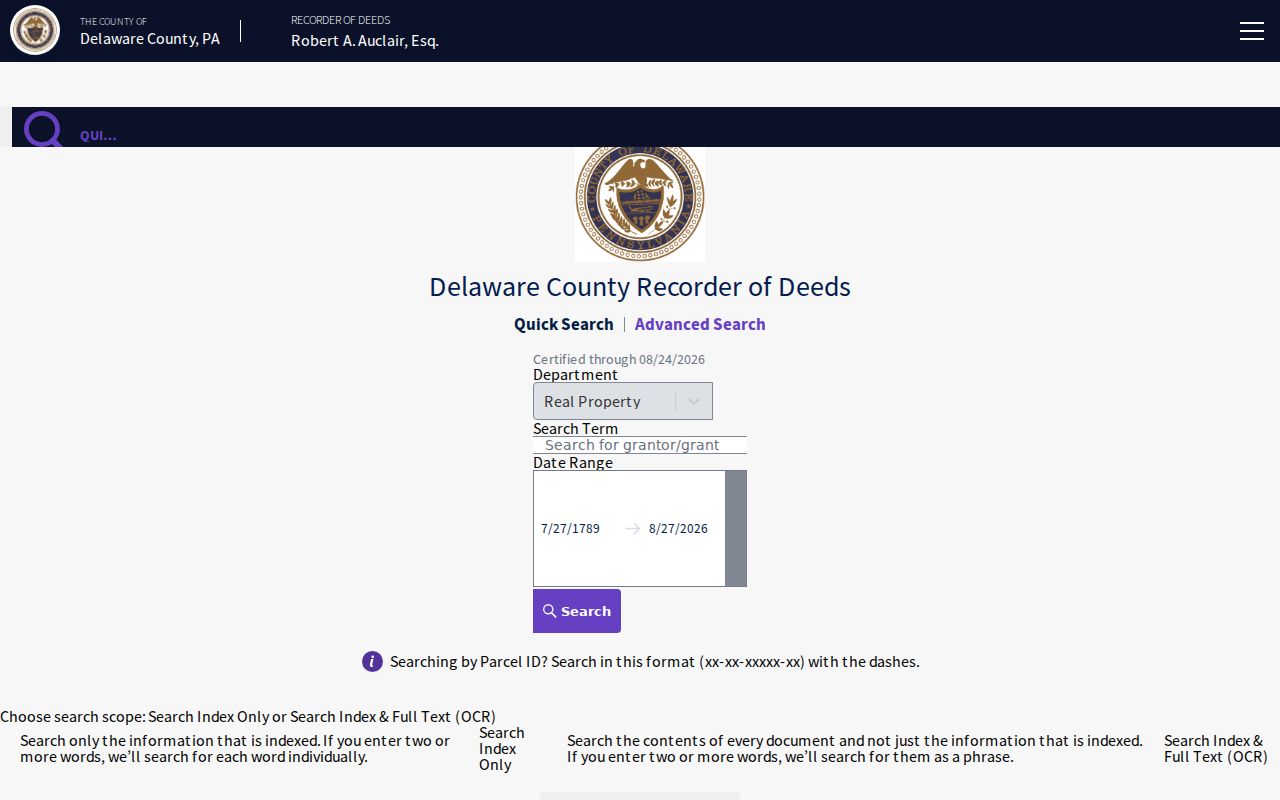
Use its filters to find a documented land-record lead, then compare the document's party, date, and land description with the parcel record.
The Recorder's older CountyFusion Online Records path remains another official route for the same kind of land-record search.
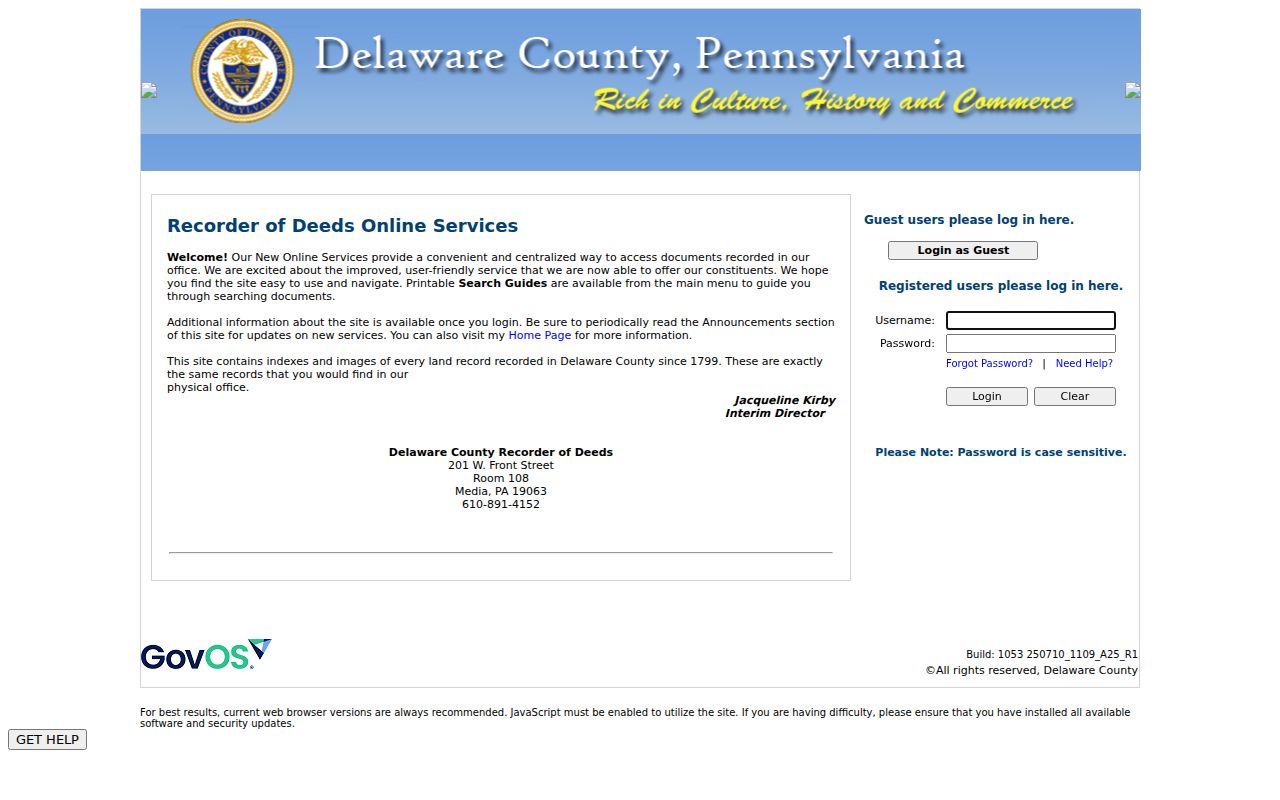
Whether using the older or newer interface, confirm the document type, recording date, and land reference before relying on a match.
Haverford Township Court Record Leads
A public court docket can sometimes help distinguish two people with the same name, but it is not a universal identity file. The statewide UJS Case Search publishes docket information where court policy allows display. Delaware County civil dockets and judgment indexes also point to C-Track Public Access. Compare a result against its court, filing date, party spelling, and local connection before attributing it to a Haverford Township resident.
The Office of Judicial Support keeps County filings at Government Center Room 127, 201 W. Front St., Media, and can be reached at 610-891-4370. Sensitive family, adoption, juvenile, sealed, and expunged material should not be described as a missing-name problem because those categories are not a complete public result set. A docket is an index to a court action, not confirmation of the facts alleged in a filing.
Pennsylvania's UJS Case Search uses several search modes, as shown below.
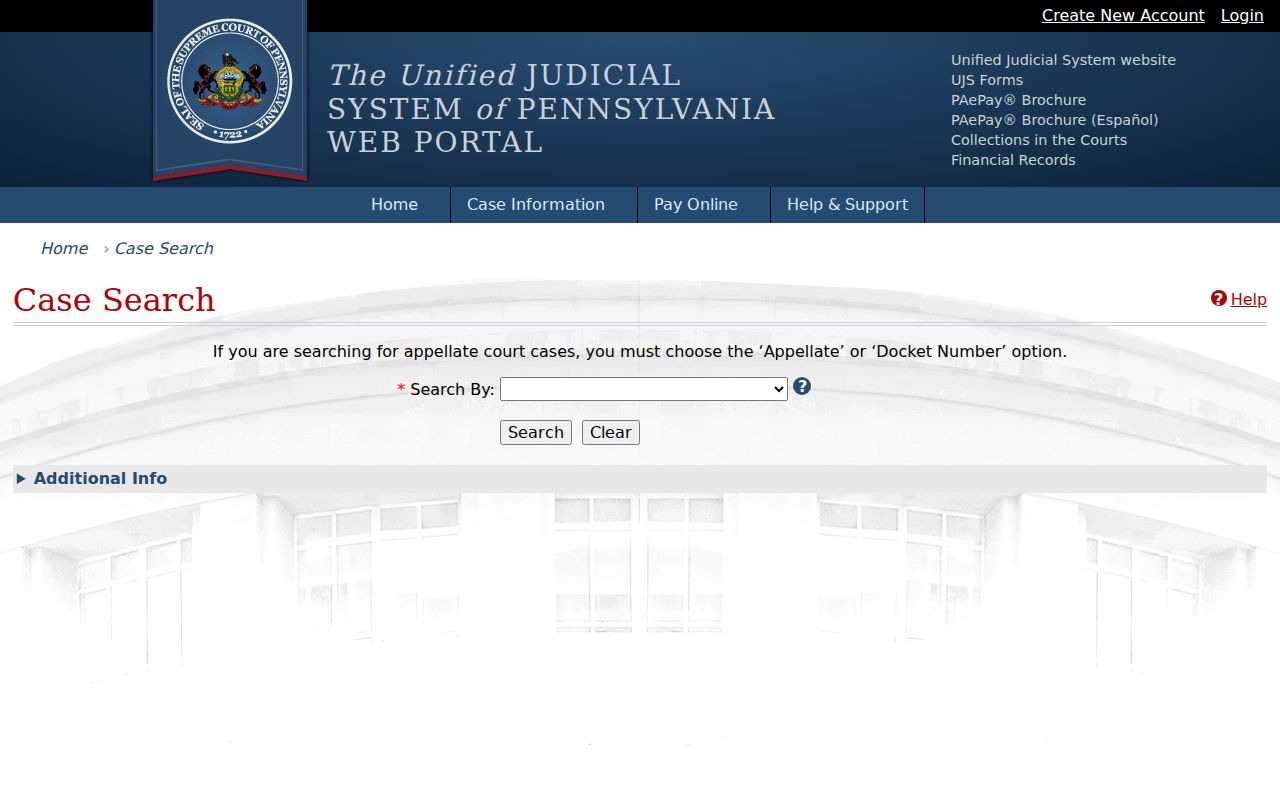
Use the result sheet as a lead to the correct court and case, not as a stand-alone description of a person.
Current Haverford Township Resident Sources
There is no single current roll of every Haverford Township resident. The closest public sources cover different relationships: parcel ownership, recorded transactions, regulated registration data, and voluntary civic contacts. The table separates their evidence so a searcher does not mistake an owner, a deed party, or a registered elector for a complete household list.
| Source | What it can place | Keeper | Access route |
|---|---|---|---|
| Real Estate/Tax System | Current parcel owner display, mailing field, site details, and sales cue | Delaware County Board of Assessment | Free address or Parcel-ID search |
| Voter-status and list channels | Individual status or a regulated civic list | Pennsylvania and Delaware County | Status page, County office, or signed list request |
| Recorder index | Grantors, grantees, and other recorded-document parties | Delaware County Recorder of Deeds | Cloud Search or CountyFusion |
| Township permit path | Known permit or application information tied to a parcel | Haverford Township Building & Codes | Known address plus Reference ID, or a targeted request |
| Civic Council member list | Public neighborhood and civic organization contacts | Haverford Township Civic Council | Public membership page |
For the one-person verification sequence, use a Haverford Township resident lookup process that compares a name with the right address and date. The official sources are more useful when their scope is kept intact than when their fields are combined into a claim they do not support.
Haverford Township Request Channels
When an index ends, identify which office created the record before making a request. The Pennsylvania Right-to-Know Law, Act 3 of 2008, generally requires a written response within five business days, although a properly noticed extension can ordinarily run up to 30 calendar days. It does not override a separate closure rule for vital records, protected voter information, confidential addresses, or restricted court material.
For Township-held material, the civilian request form names Mia Badman as Open Records Officer. Requests may be submitted at the municipal building, by fax, or by email. The Township form states a 25-cent-per-paper-side charge, postage when mailed, and possible prepayment above the stated threshold. Delaware County's Open Records route offers JustFOIA and written-request channels, including mail, hand delivery, email, and fax. Its policy requires a U.S.-resident requester and a mailing address for a County RTKL request.
Delaware County Open Records shows the County's request choices.
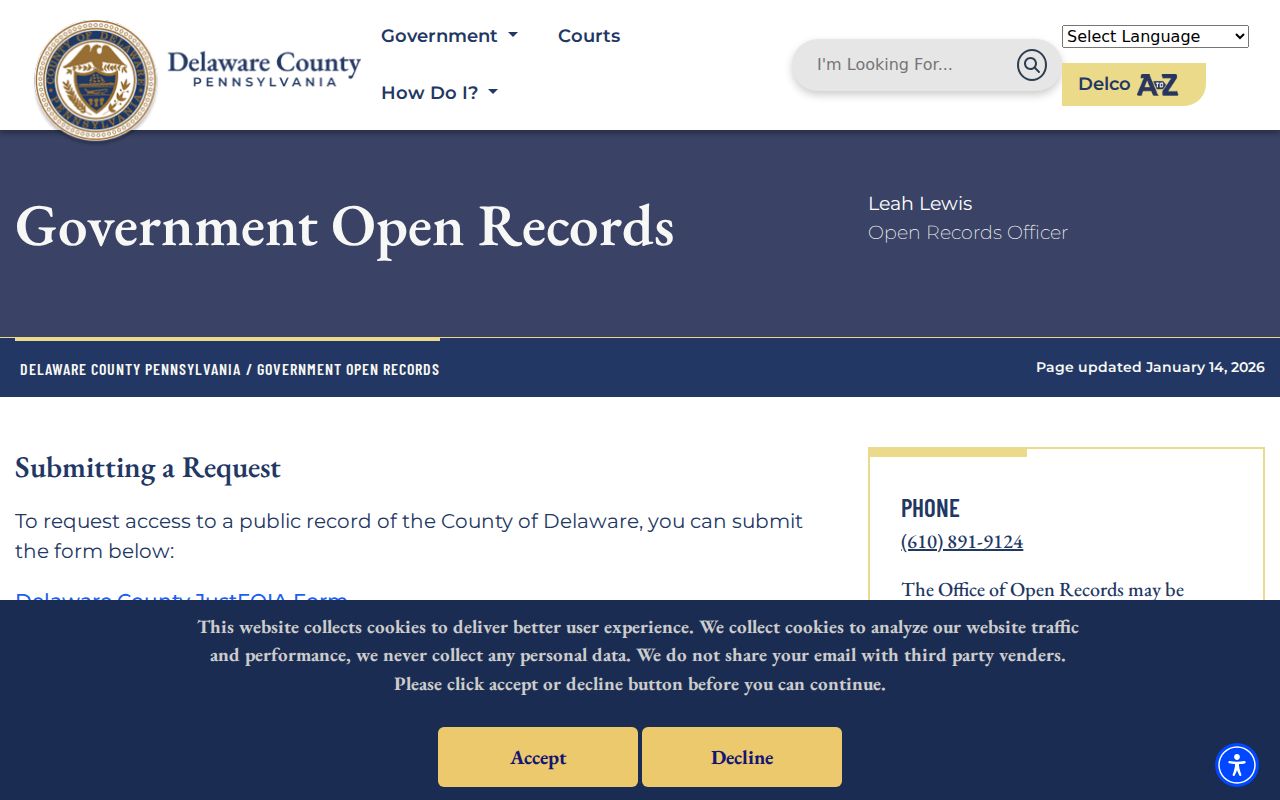
A narrow request naming a record, address, and date range is more likely to reach the correct custodian than an open-ended demand for a person search.
Haverford Township Archive Index Layer
Delaware County Archives is a serious historical alternative when a Haverford Township online search reaches its cutoff. The Archives holds most County administrative-office records from 1789 to 1950 and publishes indexes for administrations, naturalizations, wills, estate files, marriages, historic assessments, and veteran grave registrations. Its Recorder exclusion is important: use Archives for the administrative and probate trail, then go to the Recorder for deeds.
Archives staff retrieve material in the Lima reading room. Researchers register, use pencils, and may use a laptop; copies are not sent electronically. The published rules list a $10 mail minimum for one to ten pages and no credit-card payments. Those on-site and mail paths preserve access to records that a current website does not reproduce. This is especially helpful for family and heir research where a name needs a dated record series.
Delaware County Archives identifies its searchable historical indexes and access rules.
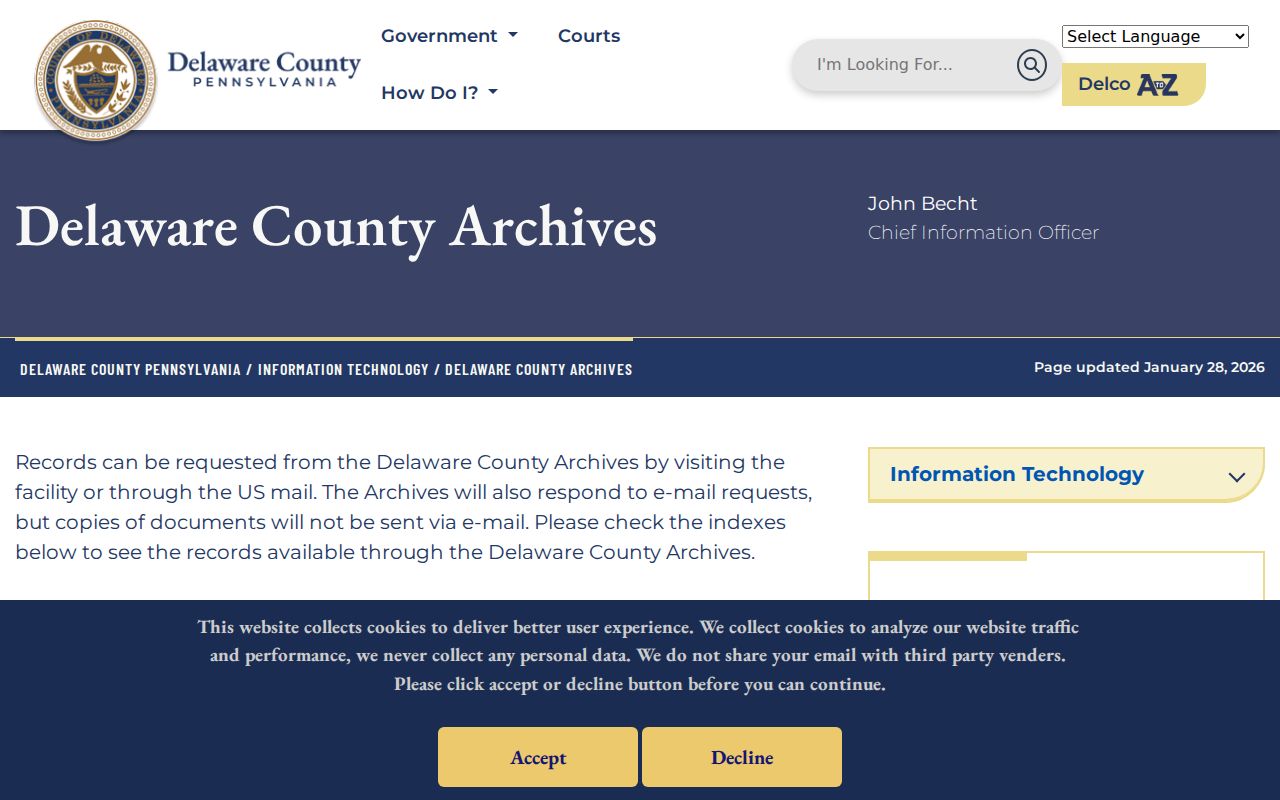
The archive screen is a reminder that land, probate, assessment, and court history often sit with separate custodians.
Note: Bring a focused surname, address, record series, and date window when asking staff to retrieve historical material.
Haverford Township Permit Record Limits
Township Building & Codes records can anchor work performed at a parcel, but the online permit center is not a general residents directory. Its existing-application screen requires both a selected Parcel Address and a Reference ID. The new-application path displays Parcel Address and Tax Pin, while the Township's Building & Codes Department handles permits, inspections, code enforcement, and contractor licensing. No official address-wide historical permit index or permit-image archive was verified in the research.
For an older construction or alteration question, use the known permit route first. If the record is offline, send a narrow address-and-date request to Building & Codes. The result may identify an application or physical-work timeline, but it should not be stretched into a claim about everyone associated with the property.
Haverford Township Building & Codes links to the local permit and license center.
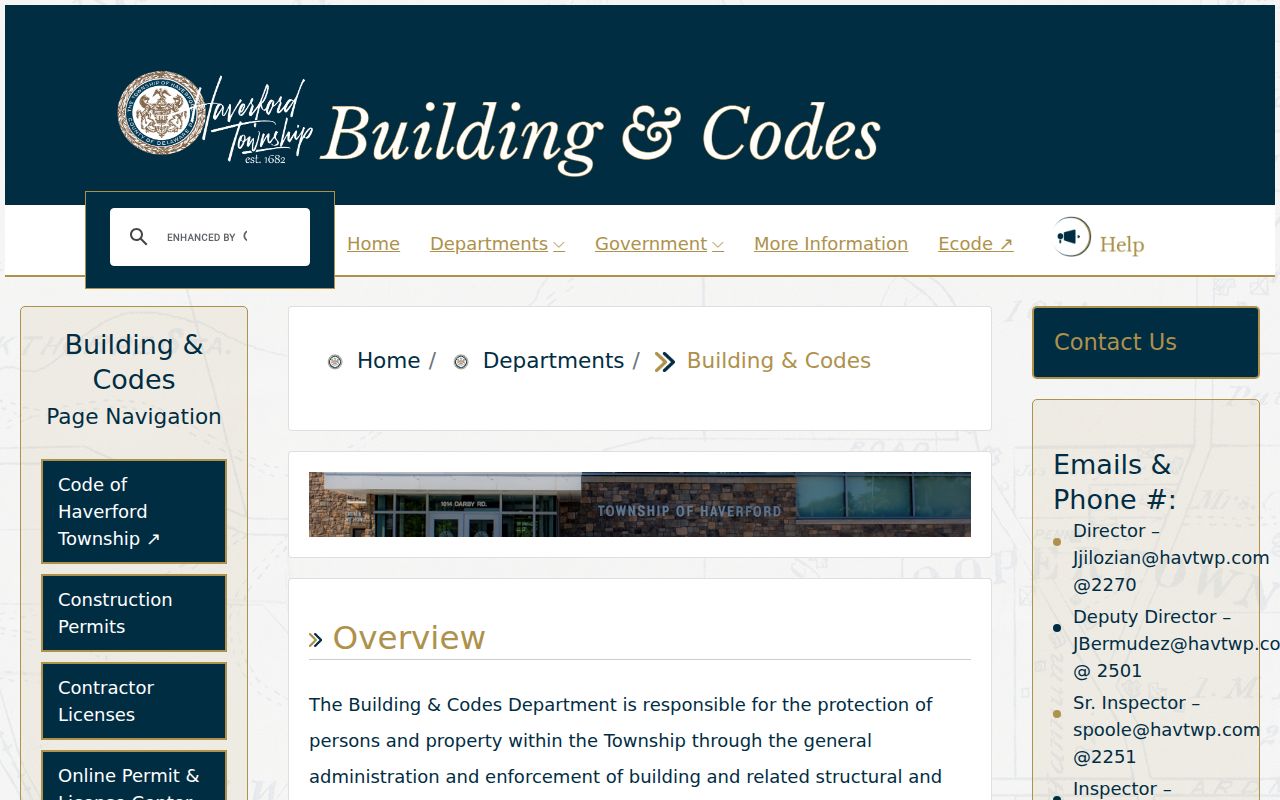
The portal's known-record design explains why a precise request can be necessary for older address evidence.
Haverford Township Address Protection
Some missing information is supposed to remain unavailable. Pennsylvania's Address Confidentiality Program gives eligible participants a substitute address for listed government records and voter registration. The program is governed by the Domestic and Sexual Violence Victim Address Confidentiality Act. Court protections, vital-record rules, and regulated voter-list access create other limits. An absent name is not a license to look for a different way around a safeguard.
Property data also has ordinary limits. The assessment system can show a parcel's site information and owner mailing field, but it is not a complete household roster. Utility records and protected addresses are not a substitute research channel. Work only with records released by their custodian, keep personal searches lawful, and correct an error with the office that maintains the record.
Pennsylvania's Address Confidentiality Program explains eligibility and enrollment.
Its protection is one reason an official portal result must never be described as a complete list of people at an address.
Haverford Township Historical Directory Shelf
Haverford Township's local printed directory shelf is specific, not continuous. The Historical Society preserves the Haverford Township Chamber of Commerce issues for 1934, 1935, 1936-1937, 1938, 1939, 1940, and 1942. It also identifies the League of Women Voters' 1962 This Is Haverford Township compilation. These volumes can connect a name, business description, street, or locality to a particular issue, but they should not be described as a year-by-year roll after 1942.
The Haverford Township Free Library's Local History Room offers a separate physical route for Township history, school publications, and yearbooks. Its collection is noncirculating and is consulted with Reference Desk assistance. The full collection and household-tracing method belongs on the Haverford Township city directories page, where the known runs and companion maps are described in depth.
- Parcel
- A mapped unit of land with an identifier used in assessment records.
- Index
- A finding aid that points to records; it is not automatically the full document image.
- Criss-cross directory
- An address-arranged directory used to approach a historical locality from a house number or street.
- Recorder trail
- The sequence of recorded document parties and land references, rather than a list of all household members.
Haverford Township Search Names
Historic Haverford research needs more than today's mailing label. “Havertown” began as a postal-delivery name on January 1, 1946. Earlier material can use Haverford Township, Main Line, Brookline, Llanerch, Manoa, Oakmont, Penfield, Merwood, or another local post-office name. Haverford Borough and Haverford College are different research targets. Searching those changing labels beside the street and date helps prevent a false match.
Historic maps add an independent check. County and Historical Society resources identify Main Line atlases and Sanborn material that can test whether a street, structure, or older locality label existed when a directory or deed was made. A map does not identify an occupant. It can, however, reveal when an address needs a historical form or a different locality search.
Note: Record the place name exactly as it appears in each source before normalizing it to a modern mailing address.